Demo · Vraag uw fabriek
AI in production planning: asking your schedule questions
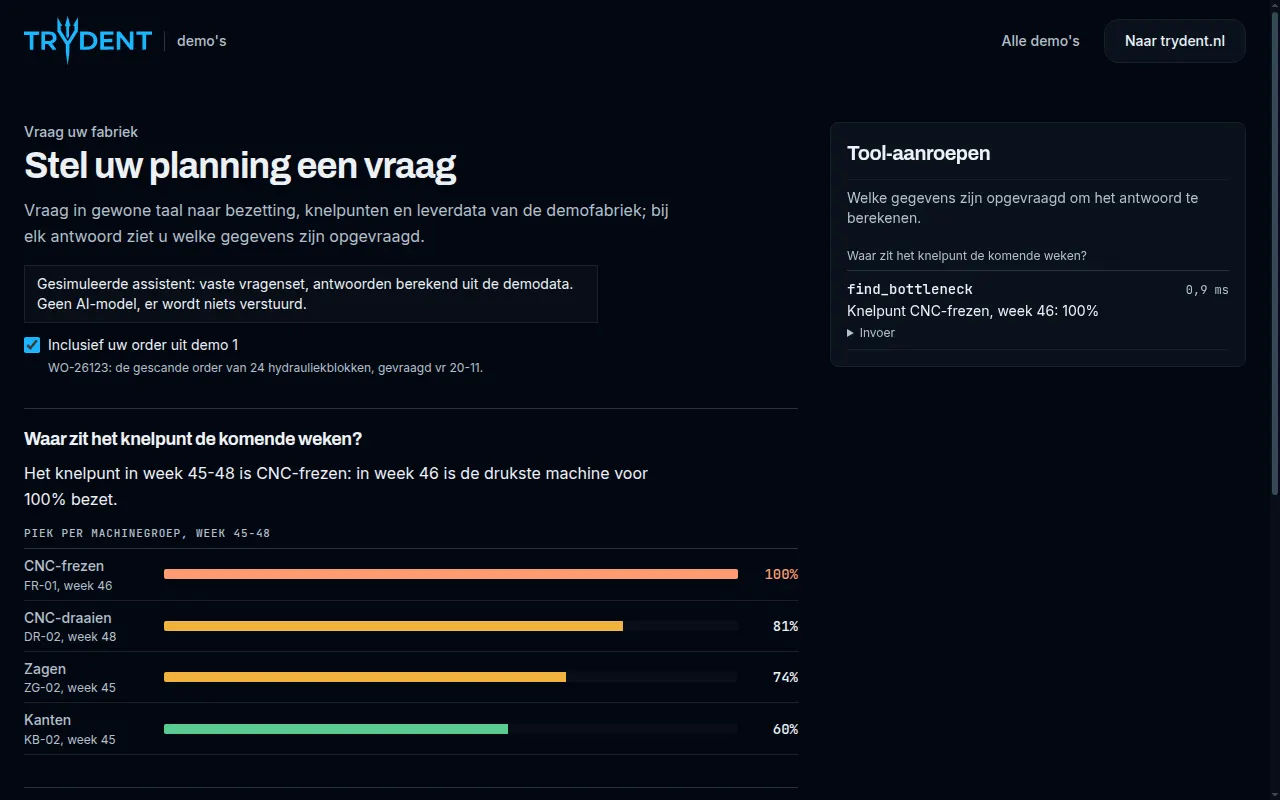
Where is the bottleneck in the coming weeks? Will this order make its date? A planner looks that up in the planning board or in Excel. In the Vraag uw fabriek demo you ask those questions in plain language and see, with every answer, which data was requested. The demo is in Dutch; this page explains how it works, and where AI is and is not involved.
Explore freely · no login · fictional data · in Dutch
Why a language model alone is not enough
A language model such as ChatGPT writes fluently, but it does not know your schedule and can make up numbers. For a question like "is the milling machine full in week 47?", a plausible answer is not good enough: it has to be right.
So in Trydent's approach the model does not calculate. It picks a tool, such as "load per machine per week", and that tool computes the answer from the planning data. The model then puts the result in plain language. A number in the answer that is not in a tool's result is rejected.
What the demo shows
The public demo uses a fixed set of questions, without a language model: the question is recognised, the right tools compute the answer, and nothing is sent anywhere. That shows the most important part of the approach, the tools and their results, without your question leaving the browser.
Every answer lists the tools that were called, with their input and how long they took. Follow-up questions work too: after "where is the bottleneck?" you can ask "and in week 47?". The order from the first demo is included in the answers, so you see what one extra order does to the schedule.
The tools behind the answers
The demo has seven tools. Each computes one thing from the schedule of the fictional demo factory: eight machines in four groups, two shifts and 22 open orders.
| Tool | What it computes | Example question (the demo is in Dutch) |
|---|---|---|
| list_machines | Machines, shifts and hours per week | Welke machines zijn er? (Which machines are there?) |
| get_load | Load per machine per week | Hoe vol zit het frezen? (How full is milling?) |
| find_bottleneck | Group with the highest load over a period | Waar zit het knelpunt? (Where is the bottleneck?) |
| get_order | Status, completion date and days late of an order | Hoe staat WO-26123 ervoor? (How is WO-26123 doing?) |
| late_orders | Orders that miss their date, with the bottleneck | Welke orders worden te laat? (Which orders will be late?) |
| what_if_shift | Effect of an extra shift, without changing the schedule | Wat als we een nachtploeg draaien? (What if we run a night shift?) |
| find_free_slot | First free slot for a job of 30 to 4800 minutes | Wanneer is er plek voor 6 uur frezen? (When is there room for 6 hours of milling?) |
Questions outside this set, such as about prices or staff, are not answered: the demo says so plainly and suggests three questions it can answer.
With your own schedule and ERP
Trydent builds assistants like this on your own data: tools on your ERP and schedule, with the access you decide. A language model can run locally, so questions and data stay in your own environment. In an introductory call, Trydent shows how an assistant answers free questions about your own data.
Frequently asked questions
- Is there AI in the demo?
- Not in the public demo. It recognises a fixed set of questions and computes the answers with tools, without a language model. Nothing is sent anywhere. The tools are the same ones a language model would call in your own environment.
- Can an AI assistant see my ERP data?
- Only through the tools built for it, and only the data those tools return. The assistant writes nothing to the schedule; the what_if_shift tool computes the effect of an extra shift without changing the schedule.
- How is this different from ChatGPT?
- ChatGPT answers from what it has learned. This approach answers from your schedule: the model picks a tool, the tool calculates, and every number in the answer must come from that calculation.
Ask a question about your own schedule
In a free 30-minute introductory call, Trydent shows how an assistant answers questions about your own orders and machines, and what that takes.
Book a free introductory call