Demo · Depot charging planning for electric trucks
Depot charging planning for electric trucks: charged by departure within the grid limit
A transport company that goes electric charges overnight at its own depot. The grid connection there is often the limit: it cannot grow, or not soon, and yet every truck must have enough in its battery for the route when it leaves. In the Depot charging planning demo you compare two ways to handle that. The demo is in Dutch; this page explains how both approaches work and what the demo calculates.
Explore freely · no login · fictional data · in Dutch
The problem: a fixed connection and fixed departure times
In many regions the power grid is full. A heavier connection can then take a long time, and sometimes a business only gets a contract that lets it draw less power during certain hours. For a transport company electrifying its fleet, grid congestion is not an abstract idea: it decides how many trucks can charge at the same time overnight.
At the same time, departure is fixed. A rigid truck that has to leave at half past three gains nothing from a full battery at six. So the question is not only whether all charging fits within the connection, but whether every truck has enough in time.
What the demo shows
The demo uses a fictional depot of Proeftransport B.V.: six rigid trucks on 44 kW chargers that leave between 03:30 and 05:30, and six tractor units on 150 kW chargers that leave between 06:00 and 08:00. They come back between 15:00 and 18:30 with a partly empty battery. The building and the workshop use power too, from 35 to 90 kW depending on the hour. The demo calculates per quarter hour, from 14:00 to 08:00 the next morning, and everything runs in your browser.
Two ways to charge
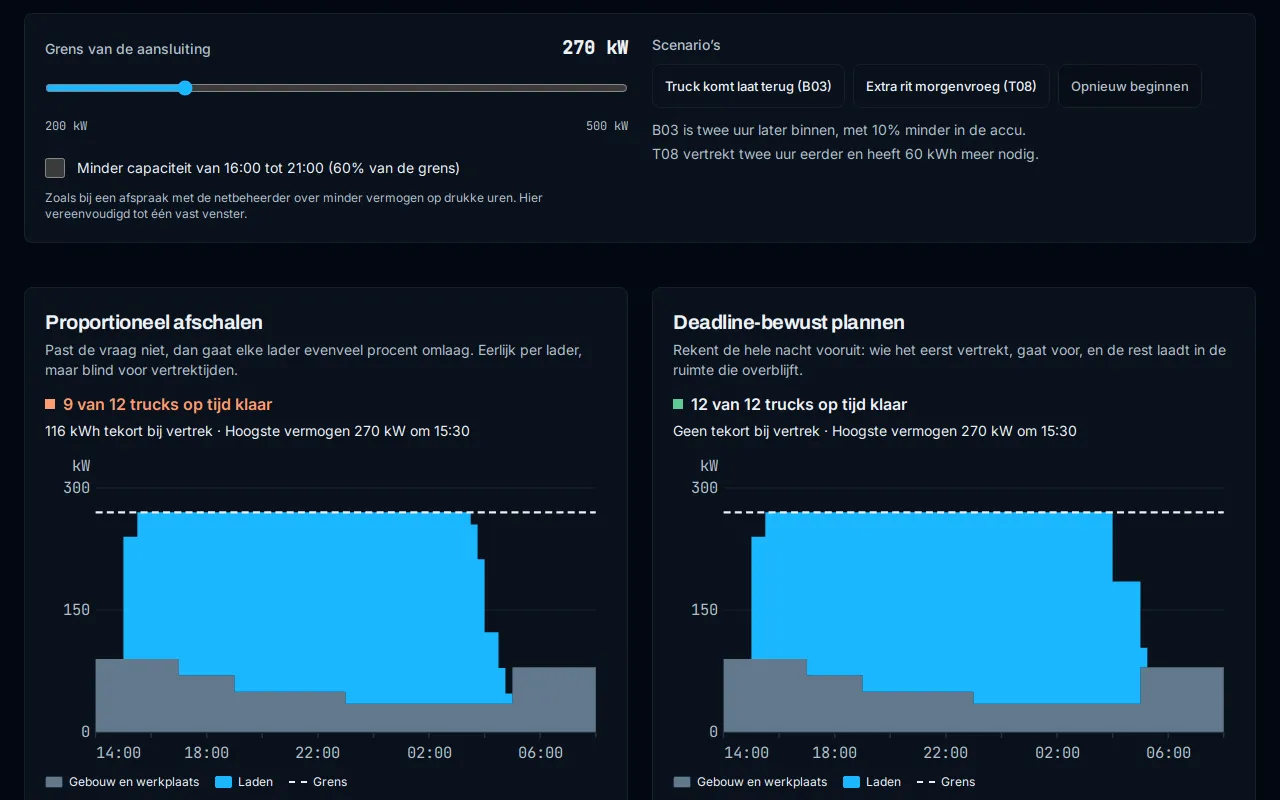
Proportional throttling looks at one quarter hour at a time. Every truck that still needs energy asks for the maximum of its charger. If that does not fit within the limit, every charger goes down by the same percentage. That is fair per charger, but blind to departure times: a rigid truck that leaves at half past three gets the same percentage as a tractor unit that stays until eight.
Deadline-aware planning works out the whole night ahead. The planner looks for a schedule in which every truck has enough when it leaves, without exceeding the limit. Whoever leaves first goes first. If such a schedule exists, the planner finds it. If it does not, you see which truck falls short, by how much, and at which limit everyone would be ready on time. If a truck cannot make it even without a grid limit, the demo says the charger is too slow for the time on the charger.
Under the hood it is a max-flow problem: energy flows from the trucks to the quarter hours in which they are on the charger, limited by the power of each charger and by what the connection still has free in that quarter hour next to the building. Trucks are added in order of departure. A truck planned earlier may move to other quarter hours to make room, but never loses energy. The calculation is in whole watt-hours per quarter hour, so the limit is never exceeded, not even by rounding.
A worked example from the demo
Two situations, calculated with the demo itself. Default: a 270 kW limit, without the window and without scenarios. Tight: a 240 kW limit, the reduced-capacity window on (16:00 to 21:00, 60 % of the limit), and both scenarios: B03 returns late and T08 has an extra trip. All data is fictional.
| Situation and approach | What happens | Ready on time |
|---|---|---|
| Default · proportional | B01, B02 and B03 (leaving 03:30 to 04:30) end up 49, 17 and 49 kWh short | 9 of 12 · 116 kWh short |
| Default · deadline-aware | Same limit and trucks; whoever leaves first goes first | 12 of 12 |
| Tight · proportional | All six rigid trucks and T08 fall short | 5 of 12 · 839 kWh short |
| Tight · deadline-aware | Rigid trucks and T08 on time; T11 and T12 (leaving 07:30 and 08:00) end up 221 and 210 kWh short | 10 of 12 · 431 kWh short |
| Tight · limit that fits | The demo finds the smallest limit in steps of 10 kW | 280 kW |
At 270 kW the difference is only the order: the connection is big enough, but proportional throttling spreads the power so that the early leavers fall short while the late trucks are ready with time to spare. In the tight situation there is no schedule in which everyone is ready on time. The planning then says exactly who falls short and reports that with a limit of 280 kW everyone is ready on time.
Try it yourself in the demo
The demo puts both approaches side by side, with the same trucks, the same limit and the same scenarios.
- Move the grid connection limit between 200 and 500 kW, in steps of 10 kW.
- Turn on the window: from 16:00 to 21:00 only 60 % of the limit is then available, as with an agreement with the grid operator about less power at busy hours. The demo simplifies this to one fixed window.
- Truck returns late: B03 is back two hours later, with 10 % less in its battery.
- Extra trip early tomorrow: T08 leaves two hours earlier and needs 60 kWh more.
- Start over resets everything to 270 kW without the window or scenarios.
- Per truck you see the departure time, what it needs, and per approach whether it is ready or how many kWh it is short, with its charge at departure.
- Per approach, a chart shows the power per quarter hour of the building and charging together against the limit. Show as table gives the same data as an hourly average.
The research behind the demo
The demo builds on research that Trydent's founder, Yvan de Wert, did during his master's: “Agent-Based Modeling for Real-Time Adaptive Charging: Enhancing Grid Stability and Renewable Integration”, Master of Applied IT, Fontys University of Applied Sciences, January 2025.
That research is an agent-based simulation of a local power grid. Solar panels, wind turbines and charging stations are each an agent, next to a time agent, a weather agent and an agent for the charge point operator (CPO). The CPO agent watches congestion on the grid and adjusts the charging speeds: down when consumption is too high, up when there is a surplus of generation. The simulation ran one week per season, with Dutch weather data. The result: with congestion-aware charging the demand curve became smoother and the evening peak was lower than with uncontrolled charging. The paper itself notes that the simulation has not yet been tested against a charging system in operation.
Proportional throttling in the demo is based on that CPO rule. What the research did not cover and the demo adds: a departure time per vehicle, the energy each truck needs, a hard grid connection limit with a contract window, and planning ahead instead of reacting moment by moment.
In a real transport company
The demo is simplified: no charging losses, no charging curve (a battery charges to full at the charger's full power), values per quarter hour and a fixed consumption profile for the building. A real planning adds those.
The data usually exists already. Departure times and trips come from the TMS or route planning, the chargers and, where available, battery levels from the charger management system, often over the open standard OCPP, and the building's consumption from the meter data of the connection. The first thing Trydent then works out is whether your current connection can handle tomorrow's trips when charging is planned by departure, which nights or trips are tight, and what a lower limit or a contract window changes about that.
Trydent builds this as custom software: charging planning around your own trips, chargers and connection, linked to the systems you already use.
Frequently asked questions
- What is charging planning for trucks at a depot?
- Deciding ahead of time which truck charges when and at what power, so every truck has enough in its battery when it leaves and the depot stays within the limit of its grid connection. The demo shows that the same connection can have more trucks ready on time when charging is planned by departure.
- What can a transport company do about grid congestion when going electric?
- Under grid congestion a heavier connection is not always quick to get. Within the connection you have, smart charging helps: sharing the power based on who leaves when. A planning also shows at which limit your trips would fit. Whether it fits your situation depends on trips, batteries, chargers and connection.
- What is the difference between charge management and charging planning for a fleet?
- Charge management for a fleet can react in the moment, like proportional throttling in the demo: if it does not fit, everyone goes down by the same amount. Charging planning looks ahead over the whole night and takes departure times and the energy each truck needs into account. Smart charging within a fixed grid connection can work either way; the demo puts them side by side.
- Are the trucks and numbers in the demo real?
- No. Proeftransport B.V. is a fictional company, and the trucks, batteries, chargers and the building's consumption are made up, but plausible. Everything runs in your browser and nothing is stored.
Bring one night of trips
In a free 30-minute introductory call, Trydent looks at your depot with you: which trucks, which chargers, which connection and which departure times. An overview of one night often says enough.
Book a free introductory call